
Buying new furniture in Calgary is expensive. Selling your old pieces for what they’re actually worth is harder than it looks. The used furniture market solves both, but only if you go in knowing how it works.
Calgary has one of the most active pre-owned furniture markets in western Canada. Frequent moves, condo downsizing, and a growing preference for buying second-hand have created a steady flow of quality pieces at prices well below retail. Solid-wood dining tables, sectionals, dressers, premium brands like Restoration Hardware and Ethan Allen – they all show up here regularly.

The tricky part is knowing where to look, what to check, and which channel is right for you. Consignment stores, thrift shops, and online marketplaces like Facebook Marketplace work very differently, and choosing the wrong one costs you either money or time.
We cover both sides: how to buy smart, and how to sell for what your furniture is actually worth.
Consignment Store, Thrift Shop, or Facebook Marketplace?
Most people lump these three together. They’re not the same, and the differences matter when you’re on either side of a transaction.
Consignment means you retain ownership of your piece until it sells. You bring it in, agree on a price with the store, and they handle the selling. When it moves, you get a cut, typically 40 to 60 per cent of the sale price. The store takes the rest as their commission. Items are usually cleaned, tagged, and displayed professionally. If your piece doesn’t sell within the agreement period (commonly 60 to 90 days), you pick it up or, depending on the contract, it may be donated.
Thrift stores operate on donations. You hand something over and walk away with nothing. The store prices it however they see fit. Selection is unpredictable, curation is minimal, and there’s no return policy if you get home and realise the drawer doesn’t close properly.
Online marketplaces like Facebook Marketplace are private sales. No curation, no guarantees, no recourse if the seller misrepresented condition. Prices can be excellent, but so can the time wasted on flaky buyers and vague listings.
For buyers: consignment usually means better-quality items at mid-range prices, with some level of accountability.
For sellers: consignment gets you more than a donation but requires patience. Thrift works if you want something gone immediately and don’t care about the return.
When Thrift Wins
If you’re dropping off a mismatched chair or a lamp that’s seen better days, thrift is the practical choice. Consignment stores generally won’t take items they can’t sell at a reasonable price, and that’s actually a good thing for buyers.

How the Consignment Works – From Drop-Off to Payout
If you’ve never consigned furniture before, here’s what actually happens.
| Step | What Happens |
|---|---|
| Intake Inspection | The store assesses your piece for condition, style, and sellability. They’re looking at structural integrity, finish quality, and whether there’s a market for it. Scratched veneer or a broken mechanism will likely get your item turned away. Clean and photograph your pieces before you bring them in – it makes a difference. |
| Pricing Agreement | The store will suggest a sale price based on condition, brand, and current demand. You can negotiate, but stores know their market. Setting the price too high means the item sits. Most stores start higher and reduce the price incrementally after 30 days if nothing happens. |
| Consignment Period | Standard agreements run 60 to 90 days. During this time, many Calgary stores also list items in an online gallery, which extends your reach beyond walk-in traffic considerably. |
| Sale and Payout | Once the item sells, you receive your share, usually by cheque or e-transfer, depending on the store. Read the contract carefully before signing: know your split, know what happens if the item isn’t sold, and know whether price reductions require your approval. |
What stores typically reject: items with pet damage, strong odours, structural damage, or pieces so specific in style that the buyer pool is tiny. Mattresses are almost universally declined.
Pricing your piece realistically: A good rule of thumb is 25 to 40 per cent of what you originally paid, for items in good condition. Premium brands like Restoration Hardware or Ethan Allen can hold closer to 50 per cent or above, particularly if they’re in excellent shape.
Living Room Pieces: Sofas, Sectionals, Ottomans – What’s Worth Buying Pre-Owned
Walk into any Calgary consignment store on a Saturday morning and you’ll notice the same thing: the living room section is packed. Sofas, sectionals, ottomans, side tables – it’s the most active category by volume, which works in a buyer’s favour. More selection means more competition between sellers, and that keeps prices honest.
Sofas and Sectionals: What to Check
Larger sectionals are particularly common in Calgary’s resale market, driven by condo owners downsizing or changing floor plans. Before you commit:
- Press the frame corners. There should be no wobble or flex. A solid hardwood or engineered-wood frame will feel completely rigid.
- Sit on every section. Cushion support should be even. If one seat is significantly softer than the others, the foam is breaking down unevenly.
- Lift a cushion and look underneath. Check for repairs, staining, or hidden damage. Sellers don’t always volunteer this information.
- Do the smell test. Upholstered furniture holds odours. Pet smells in particular are extremely difficult to remove.
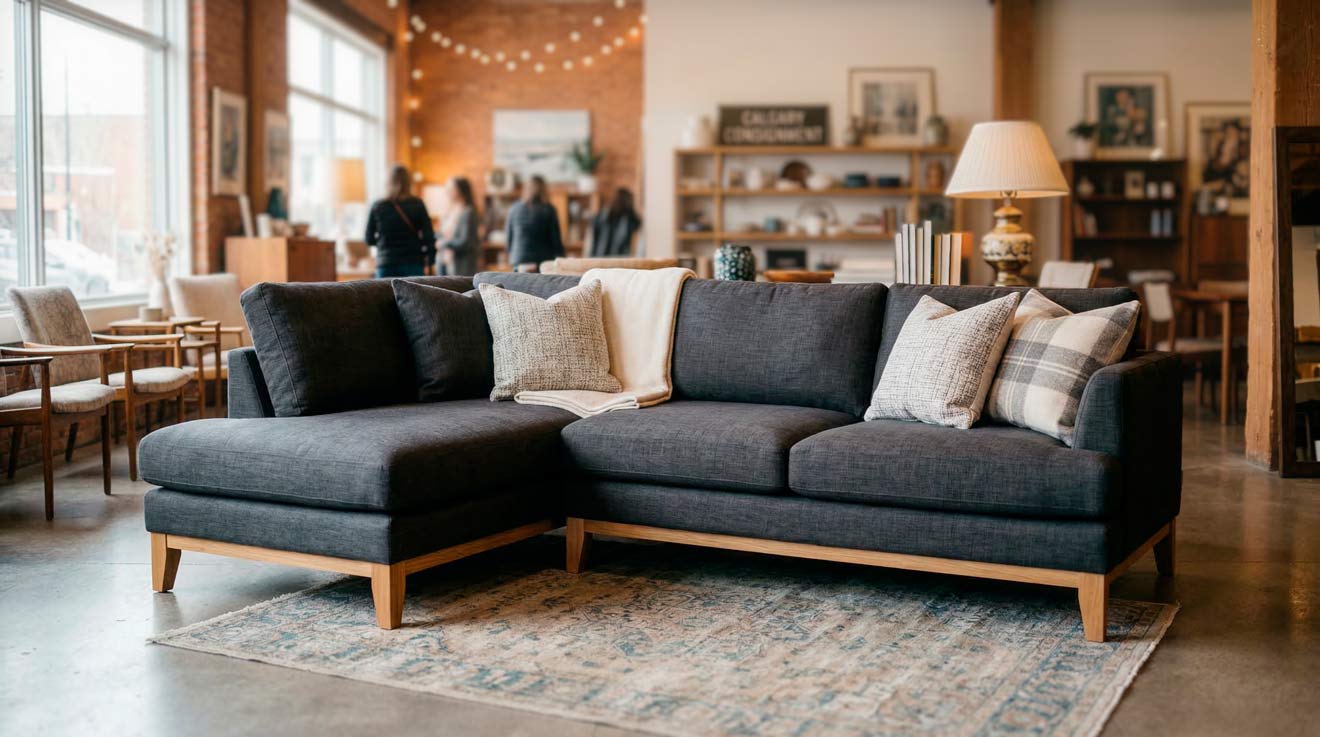
Birchwood-frame sofas hold up well. Pieces from brands like Hancock & Moore, which use eight-way hand-tied construction, are worth looking for – they’re built to last decades and often appear on the consignment market when owners renovate or downsize.
Side Tables, Coffee Tables, and Ottomans: The Easy Win
These are low-risk pre-owned purchases. A glass coffee table or a solid-wood side table has no moving parts and minimal wear points. Ottomans are worth inspecting for cushion resilience and base stability, but beyond that, they’re easy. Metal side tables in particular tend to age well and are frequently underpriced in consignment settings.
Rocking chairs are another overlooked category, solid hardwood pieces often surface for a fraction of their retail price, and they don’t go out of style.
Bedroom and Dining Room Pieces: Where Pre-Owned Really Pays Off
If there’s one category worth slowing down for in Calgary’s used furniture market, it’s solid wood bedroom and dining pieces. A well-made dresser or dining table from 20 years ago is often structurally better than anything new at twice the price, and in our experience, these are the pieces people regret passing up most.
Calgary buyers who have gone this route tend to stick with it. “We’ve had one for nearly 18 years and our whole family still loves it,” one r/Calgary commenter wrote about their Canadian-made sofa – a comment that got plenty of agreement in the thread. The same logic applies to solid wood case pieces: buy quality once, pre-owned, and it outlasts everything you’d buy new at a similar price point.
Dressers: Solid Wood vs. Veneer
Tap the surface lightly with your knuckle. A hollow sound indicates veneer over particle board. A solid thud means solid wood. Then pull out a drawer: the slides should be smooth, the joints tight. Dovetail joinery in the corners is a sign of quality construction. Brands like Ethan Allen, Kincaid, and Stanley Furniture built their reputations on exactly this kind of work, and pieces from these makers show up regularly in Calgary consignment.
A white dresser with clean lines and solid wood construction is one of the most reliably sellable pieces in the market, which also means buyers need to move quickly when one appears.
Dining Tables: The Sweet Spot
A solid dining table is difficult to damage and easy to refinish. Round tables, oval pedestal styles, and farmhouse designs all have enduring appeal. Check the base for stability (no wobble when you press the corners), inspect the surface for deep scratches or heat damage, and open any extension leaves to confirm they’re warp-free and align properly.
Pre-owned dining chairs are worth inspecting individually. Sit on each one. Check the legs for repairs and the joints where the legs meet the seat. A dining set with eight chairs should have all eight checked – it only takes one wobbly chair to create an ongoing frustration.
Hutches and Buffets: Underrated and Underpriced
These pieces are genuinely undervalued in the resale market. A solid-wood buffet or China cabinet from a quality manufacturer can sell new for several thousand dollars and appear in consignment for a fraction of that. They’re large and difficult to move, which keeps the buyer pool smaller and prices lower than they probably should be.
Counter-height stools are another strong category. Calgary kitchens with islands have driven consistent demand, and the turnover rate on these is high – people upgrade frequently, meaning good-quality stools enter the market regularly.
Vintage Furniture in Calgary: What Holds Value and What Doesn’t
“Vintage” gets used loosely, but in practical terms it means pieces roughly 20 to 100 years old. Older than that, you’re into antique territory. The distinction matters because value drivers are different.
In Calgary’s market, the styles with the most consistent demand are mid-century modern (think tapered legs, clean lines, walnut finishes), art deco (geometric forms, lacquered surfaces, brass hardware), and industrial (raw steel frames, reclaimed wood tops). These aesthetics have maintained relevance through multiple interior design cycles and attract buyers who are specifically looking for them.
What doesn’t hold value: 1990s laminate furniture, mass-produced pine pieces, particle board construction with peeling edges. These age poorly and are difficult to refinish or repair meaningfully.
Spotting genuine vintage versus reproduction: Check the joinery. Pre-1960s furniture typically uses hand-cut dovetails and mortise-and-tenon joints. Look for maker’s marks on the underside or inside of drawers. Branded pieces from known manufacturers are far easier to verify and price. Original hardware intact is a strong positive indicator. Replaced hardware, particularly if it doesn’t quite fit, suggests repairs or alterations that may affect value.
Restoration Hardware, Ethan Allen, Pottery Barn: Buying Premium Brands Pre-Owned
Premium furniture brands enter Calgary’s consignment market consistently, driven by home renovations, upsizing, downsizing, and lifestyle changes. This is where pre-owned buyers can access genuinely high-quality pieces at significant savings.
Restoration Hardware (RH) pieces hold their resale value better than most. The brand’s focus on weight, finish quality, and natural materials means pieces age well and are recognisable to buyers. If you find an RH side table or bookcase in good condition, the price will reflect that – but it will still be substantially below retail.
Ethan Allen is another brand worth seeking out. Their solid wood construction and consistent finishing standards mean a 15-year-old Ethan Allen dresser often outperforms new furniture from mid-market retailers.
Pottery Barn, William Switzer, Hooker Furniture, and Hancock & Moore all appear periodically and are worth recognising on sight.
When buying branded pre-owned pieces: verify the original finish is intact rather than repainted, check upholstery carefully (reupholstering quality pieces is viable but adds cost), and confirm structural integrity. For bookcases and display cabinets, check that shelves are level and brackets are secure.
Home Office and Storage Furniture
The pandemic-driven shift to remote work created a sustained surplus of home office furniture in Calgary’s resale market. This is good news for buyers. Solid wood desks, filing cabinets, and bookcases that were purchased during the 2020 to 2022 period are now cycling back through consignment as people consolidate space or return to offices.
A well-made desk, like a Vilas maple piece or a comparable solid hardwood writing desk, will outlast several generations of flat-pack alternatives and can be refinished if the surface shows wear. Bookcases are worth measuring carefully before you buy. The most common issue isn’t quality, it’s fit.
Curio cabinets and glass-fronted display cases are frequently underpriced because they’re considered niche. If you have a use for them, that works in your favour. TV stands and entertainment units turn over quickly because screen sizes and mounting preferences change, which means quality pieces enter the market often and sell for less than their condition warrants.
Where to Find Consignment Furniture Stores in Calgary
Finding good used furniture in Calgary takes about 20 minutes of prep and saves a lot of wasted driving. The stores aren’t evenly spread, there are clusters in the NE and SE, fewer options on the west side, and not all of them are worth the trip. Here’s what we’d check before heading out:
Google Maps is the most practical starting point. Search “furniture consignment Calgary” or “used furniture stores Calgary” and filter by rating and distance. Read the reviews with some scepticism – a store with 80 reviews averaging 4.3 stars tells you more than one with six reviews averaging 5.0. Look specifically for comments about item quality, pricing consistency, and how staff handle disputes or misrepresented pieces.
The Better Business Bureau directory lists accredited businesses in the Calgary area with complaint histories you can read. A store that’s been operating for 10-plus years with a clean BBB record is a reasonable signal of reliability.
Kijiji’s furniture section is worth checking for private sales alongside consignment listings. Filter by “seller type” to separate store listings from individuals. Prices are often lower than consignment stores, but condition descriptions vary wildly – always ask for additional photos and inspect in person before committing.
Facebook Marketplace follows the same logic. The search filters for “used” and location radius are useful. For larger pieces like sectionals or dining sets, sellers are often motivated to negotiate on price if you can arrange your own transport.
What to Check Before You Visit a Store
A few things worth confirming before you make the trip:
- Do they have an online gallery or Instagram? Stores that photograph and list inventory regularly tend to move stock faster and curate more carefully.
- What’s their consignment split and contract length? Legitimate stores are upfront about this.
- Do they specialise in furniture, or is it a general second-hand shop? Dedicated furniture consignment stores tend to have better curation and more consistent quality standards.
- What’s their return or dispute policy? Most consignment stores sell as-is, but knowing this ahead of time prevents surprises.
If you’re selling rather than buying, call ahead before hauling furniture across the city. Most stores do intake by appointment and have specific criteria for what they accept. Showing up unannounced with a truckload of items rarely goes well for anyone.
Questions People Ask About Buying and Consigning Furniture in Calgary
For buyers, yes. You can typically save 40 to 70 per cent compared to retail on items that are structurally sound and well-maintained. For sellers, the payoff is better than donation and less labour-intensive than running your own Marketplace listing. The tradeoff is time: consignment requires patience on both sides.
Most items move within 30 to 90 days at a store that prices appropriately. Spring (March to May) and fall (September to October) tend to be the busiest periods, driven by moving season and home refreshes. Oversized or highly specific pieces can take longer.
Dining tables, sofas, dressers, and bookcases consistently move quickly. These are items with broad appeal, easy repurposing, and strong demand relative to supply.
A starting point: 25 to 40 per cent of the original retail price for items in good condition. Adjust upward for premium brands, original hardware, and excellent condition. Adjust downward for visible wear, repairs, or highly specific styles with smaller buyer pools. If your item sat unsold for a full consignment period, the market is telling you something about the price.
Not necessarily. Pricing depends on how well the individual store has researched a piece’s provenance and demand. A knowledgeable store will price vintage appropriately. A store that doesn’t specialise in vintage may undervalue or overprice based on appearance alone. This creates an opportunity for buyers who know what they’re looking at.
This is an independent informational resource about Calgary’s pre-owned furniture market. We are not affiliated with any business, store, or previous operator that may have used this domain. All brand names referenced are the property of their respective owners and are mentioned for informational purposes only.